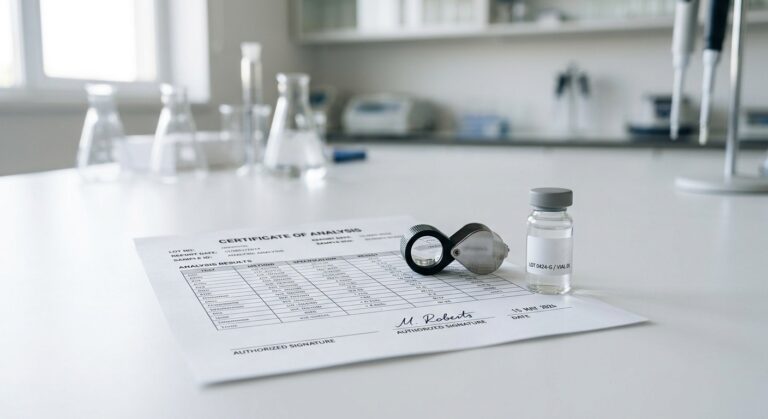
Is 99.0% a pass? Measurement spread and decision rules on a peptide COA
For qualified researchers. Clarion Peptides products are sold for laboratory research use only. They are not for people or animals. Updated November 9, 2026.
The short answer. A purity number like 99.1% is a test result. It always has some spread. Say the limit is 99.0%. A result just above the line may not truly be above it. Labs settle this with a written rule. Most peptide reports, ours included, print the number with no limit, no pass or fail, and no rule. So a “pass” on a product page is the seller’s own call.
The same sample does not give the same number twice
Run one sample twice on the same machine, and the purity figure can move a little. The ICH guideline on validating lab methods names three levels of this spread:2
- Repeatability: the spread under the same conditions over a short time.
- Intermediate precision: the spread inside one lab across different days, analysts or equipment.
- Reproducibility: the spread between different labs.
So a reported 99.1% stands for a small range of values the true number could take. When that range crosses 99.0%, the answer to “is it a pass?” depends on the rule you use.
Two common decision rules
ILAC, the global association of lab accreditation bodies, describes the common rules in its guide ILAC-G8.1 Two matter most here.
Simple acceptance. Compare the result with the limit as it is. 99.1% against a 99.0% limit is a pass. ILAC-G8 also calls this “shared risk”. When a result sits exactly on the limit, the chance that the true value is on the wrong side can be as high as 50%.1
Guard band. Move the line inward by a set margin before you compare. With a 99.0% limit and a 0.2-point guard band, a result has to reach 99.2% to pass. This lowers the chance of passing a sample that is really below the limit. It raises the chance of failing one that is really above it.1 JCGM 106 sets out the math behind these risks.3
| Result | Simple acceptance, limit 99.0% | Guard band 0.2, limit 99.0% |
| 99.6% | Pass | Pass |
| 99.1% | Pass | Not a pass |
| 98.9% | Not a pass | Not a pass |
Made-up numbers, to show how the rule changes the answer. Not from any real lot.
What accredited labs must write down
ISO/IEC 17025 is the standard that testing labs are accredited to. ILAC-G8 quotes its clause 7.8.6. When a lab states that a result meets a specification, it must document the decision rule it used. The report must say which results the statement covers, which specification was met or not met, and which decision rule was applied.1 A report with no limit and no pass or fail makes no such statement. It just reports a number.
What our own reports show
Our Freedom Diagnostics report for Selank prints “Purity (HPLC-UV) 99.78%”. It does not print a limit, a pass or fail, or a measurement uncertainty. Our Janoshik report for Ipamorelin prints “Purity 99.765%” in the same way. So these reports state numbers, not a verdict.4
When our product pages say “>99%” or round 99.765% to 99.8%, that is us reading the lab’s number. The lab did not make that call. Across the nine Freedom reports in our purity article, the margin over 99% runs from 0.06 to 0.78 points. The thinnest is our FOXO4-DRI lot, at 99.06%. The reports do not state their uncertainty, so we cannot tell you how big the spread around these numbers is.
Questions to ask about any “99% pass”
- What is the limit, and who set it: the lab or the seller?
- Does the report state a measurement uncertainty, or show repeat results?
- Which decision rule was used: simple acceptance or a guard band?
- Is the “pass” printed by the lab, or written by the seller next to the lab’s number?
Purity is also only one number on a report. What it does and does not count is in HPLC purity vs peptide content. How to read every line: how to read a peptide COA.
Sources
- ILAC. Guidelines on Decision Rules and Statements of Conformity, ILAC-G8:09/2019. ilac.org, guidance series. This document quotes ISO/IEC 17025:2017 clauses 7.8.6.1 and 7.8.6.2.
- ICH. Validation of Analytical Procedures Q2(R2), adopted November 1, 2023. database.ich.org. Glossary: repeatability, intermediate precision, reproducibility.
- JCGM. Evaluation of measurement data: the role of measurement uncertainty in conformity assessment, JCGM 106:2012. bipm.org.
- Freedom Diagnostics Testing reports Clar2607240045 (Selank) and Clar2607240039 (FOXO4-DRI), and Janoshik report #109931 (Ipamorelin), read November 9, 2026.
All Clarion Peptides products are for laboratory research use only. Not for human or veterinary use. Nothing on this page is a claim about the effects of any compound.