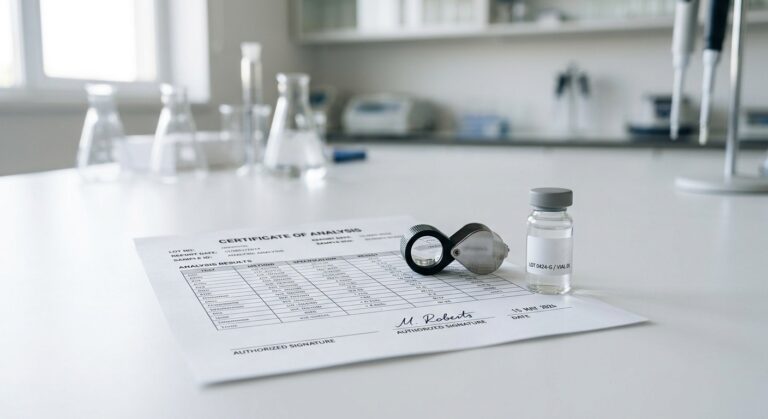
Endotoxin in research peptides: what it is, how it is tested, and why most reports skip it
For qualified researchers. Clarion Peptides products are sold for laboratory research use only. They are not for people or animals. Updated November 10, 2026.
The short answer. Endotoxin comes from the outer wall of some bacteria. Tiny amounts can switch on some immune cells in a dish. That can throw off cell tests. Labs check for it with a test called LAL. A purity test does not measure it. None of our current lab reports has an endotoxin result.
What endotoxin is
Endotoxin is found in the outer membrane of all gram-negative bacteria.1 It is a large molecule, often called LPS, short for lipopolysaccharide. It can end up in a material made or handled where those bacteria were present, even if the bacteria themselves are gone.
Why it matters for lab work
Some cells react to very small amounts of endotoxin. In one study, researchers exposed human immune cells in culture to LPS at 0.002 to 2 ng/mL. Some cell types were switched on by amounts equal to the contamination they found in some store-bought proteins.2 The authors’ conclusion: when working with cells that are sensitive to LPS, even low endotoxin contamination may produce misleading data.2
So if a peptide goes into a cell-based experiment, an unknown amount of endotoxin is an unknown variable in the result.
How it is measured
The standard test is the LAL test, short for Limulus amebocyte lysate. It uses a reagent made from horseshoe crab blood cells that reacts to endotoxin. It replaced an older test done in rabbits and is now the most widely used method.1 The LAL test comes in more than one format. FDA guidance says that if results disagree, the gel-clot method decides.3
Results are given in endotoxin units (EU), usually per milligram or per millilitre. A useful result names the method, the unit, and the lowest level the test could detect.
Why a purity number does not cover it
HPLC purity compares the main peptide peak with the other peptide-related peaks. Endotoxin is a separate substance that needs its own test. A sample can be 99.8% pure by HPLC and still carry endotoxin. More on what purity counts: HPLC purity vs peptide content.
What our reports show
None of our current lab reports includes an endotoxin result. Our Freedom Diagnostics reports cover identity, purity and net content. Our older Janoshik reports cover purity and an amount.
The test is available in this market. Janoshik’s public list of client tests includes endotoxin analyses.4 If your experiment uses cells that are sensitive to endotoxin, ask the seller for an endotoxin result before you buy, or have the material tested yourself.
Questions to ask
- Was the lot tested for endotoxin at all?
- Which method, and what was the detection limit?
- What unit: EU per mg, or EU per mL of a solution at what strength?
- Who ordered the test: the seller, or its supplier? See a supplier’s certificate vs a test the seller orders.
Sources
- Su W, Ding X. Methods of endotoxin detection. J Lab Autom. 2015;20(4):354-64. doi:10.1177/2211068215572136. PMID 25720597.
- Schwarz H, Schmittner M, Duschl A, Horejs-Hoeck J. Residual endotoxin contaminations in recombinant proteins are sufficient to activate human CD1c+ dendritic cells. PLoS One. 2014;9(12):e113840. doi:10.1371/journal.pone.0113840. PMID 25478795.
- US FDA. Guidance for Industry: Pyrogen and Endotoxins Testing: Questions and Answers. fda.gov.
- Janoshik Analytical, public test list: public.janoshik.com (read November 10, 2026).
All Clarion Peptides products are for laboratory research use only. Not for human or veterinary use. Nothing on this page is a claim about the effects of any compound.