
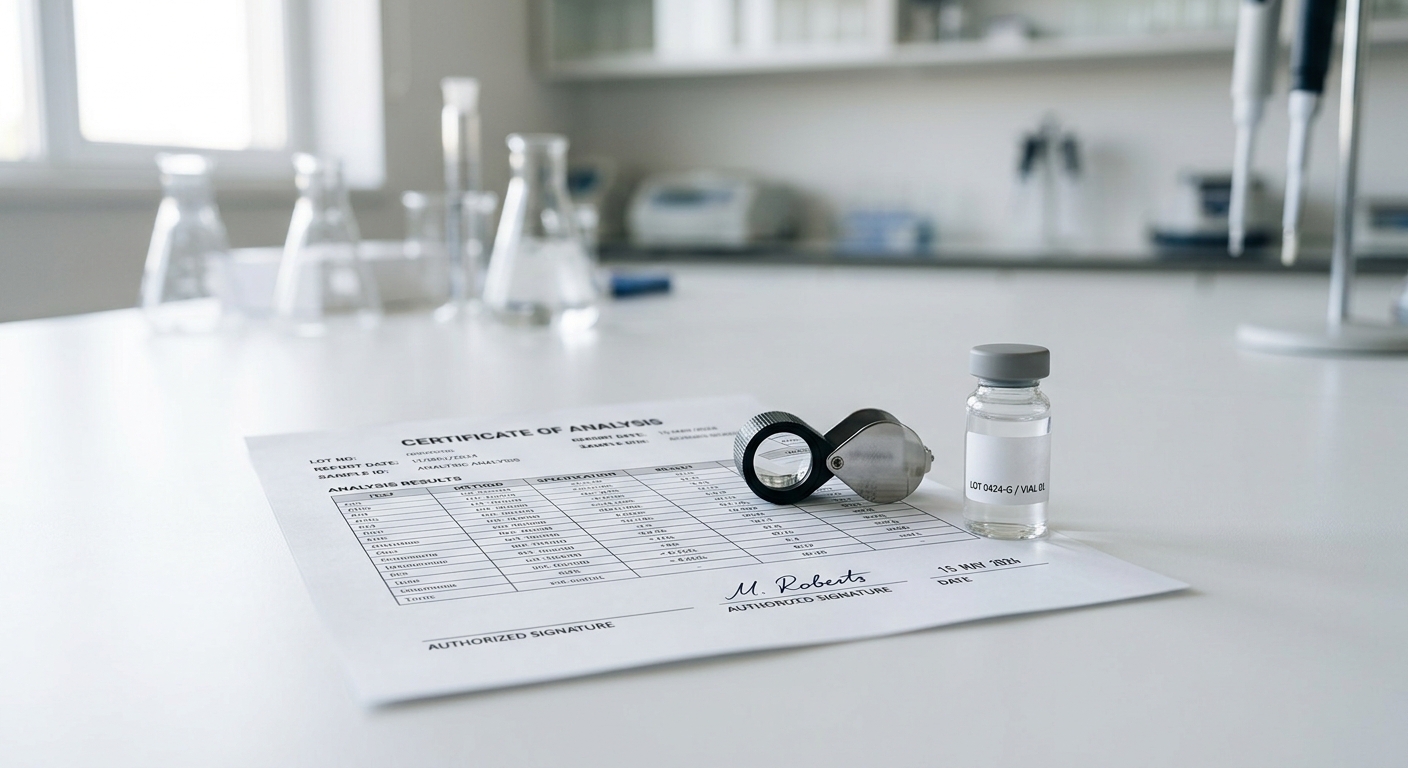
How to read a peptide Certificate of Analysis
Updated November 5, 2026. For qualified researchers. Clarion Peptides products are sold for laboratory research use only.
The short answer. A certificate of analysis, or COA, is a lab report on one batch of a peptide. You can read one in five steps. Find the lab’s name and the report number. Find the batch number and check that it is the batch you received. Check that the weight the lab measured matches the peptide’s formula. Read the purity, as a percent, and look for the chart behind it. Then ask the lab, not the seller, to confirm the report. If any step fails, treat the report as unproven.
A COA is the only evidence a researcher has that the powder in the vial is the compound they ordered. The label, the brand and the price are all claims. The report is the chemistry. Plenty of reports in circulation are borrowed from an older batch, missing the chart behind the number, or made by the seller with no outside lab involved, so it pays to read every one closely.
What a research-peptide report usually shows
The third-party labs that test research peptides, such as Freedom Diagnostics Testing and Janoshik Analytical, usually report these items:
- Who and when: the lab’s name, a report or accession number, a search code or verification key, the client the report was issued to, and the dates the sample was received and reported.
- Which batch: the lot or batch number, and the product name and vial size that were tested.
- Identity: whether mass spectrometry found the right molecule.
- Purity: the share of the HPLC signal that belongs to the main peak, as a percent, with the chromatogram shown.
- Net content: how many milligrams of peptide the lab measured in the vial.
A full pharmaceutical release certificate goes further. It adds water content, counter-ion content, amino-acid analysis, an impurity-by-impurity table, an expiry or retest date, and a quality-assurance sign-off. Most research-peptide reports, including ours, don’t include those extra tests. That’s normal in this market, but it changes what the numbers mean: the purity figure tells you how clean the peptide is, not how much of the powder’s weight is peptide. The sections below explain each line.
Line by line
Identity (mass spectrometry)
Identity confirms the compound is what the label says. For peptides this is usually done by mass spectrometry: the lab compares the mass it observed with the mass expected from the formula. The expected numbers come from chemistry, so you can work them out yourself without trusting anyone. Most reports show the molecule with one or two extra protons attached, written [M+H]+ or [M+2H]2+, so look for the charge state next to the number. A result is a pass or a fail: it either is the right molecule or it isn’t. Expected masses for 22 research peptides are in our peptide mass reference table.
Purity (HPLC with UV detection, %)
Purity is the percentage of the total peak area in the HPLC chromatogram that belongs to the main peak. Research-grade results are usually 98% or higher. A purity number with no chromatogram behind it can’t be checked, so look for the chart: one tall, sharp peak with little else around it is what a clean sample looks like. Purity is a share of light, not of weight: HPLC purity vs peptide content explains the difference. How a lab decides whether a number passes a limit: Is 99.0% a pass? What a purity number does not cover: peptide aggregation.
Net content (mg)
Net content is how much peptide the lab measured in the vial, in milligrams. It is not the same thing as purity. A sample can be 99% pure and still hold more or less than the amount on the label, because vials are filled by weight and the dry powder also contains salt and water. A pharmaceutical certificate would report this as a percentage by amino-acid analysis; research-peptide labs usually report the milligrams found. Read the number against the label, and ask the seller if it’s far below it. What that amount is measured against: reference standards.
Water and counter-ion (when they’re reported)
Freeze-dried peptides pull water from the air, and most are supplied as an acetate or TFA salt. A full certificate measures both: water by Karl Fischer titration and the salt by ion chromatography. Neither is a contaminant, but both count against the share of the powder that is peptide. If your research needs those numbers, ask for them before you buy, because most research-peptide reports leave them out.
A real report, line by line
Here is one of our own reports, read the way this page suggests: Freedom Diagnostics Testing, search code Clar2607240045, for our Selank lot SK10. You can open it on the lab’s own database at coas.freedomdiagnosticstesting.com/Clar2607240045.pdf.
| Lab and number | Freedom Diagnostics Testing, accession 2607240045, search code Clar2607240045. |
| Client | Clarion Peptides. We sent the sample ourselves, so this is a test the vendor ordered on its own stock. |
| Dates | Received July 24, 2026. Reported July 28, 2026. |
| Batch | Lot SK10, product “Selank 10mg”. |
| Identity | Confirmed by LC-MS. The mass spectrum shows [M+H]+ at 752.4 and [M+2H]2+ at 376.8. Selank’s formula, C33H57N11O9, predicts 752.44 and 376.72, so the molecule matches. |
| Purity | 99.78% by HPLC with UV detection. The chromatogram shows one sharp main peak. |
| Net content | 13.01 mg measured in a vial labeled 10 mg. |
| Not on this report | Water, counter-ion, amino-acid analysis and a retest date. That’s typical for research-peptide reports, as explained above. |
When a report doesn’t measure purity
Not every report includes a purity number. Some only measure how much of the compound is in the vial. One of our own lots is an example: the Janoshik report for our NAD+ lot (#111311, ordered by our supplier) lists 594.69 mg of NAD+ in a 500 mg vial and nothing else. That confirms content, not purity, so our product page doesn’t list a purity for that lot. If a seller quotes a purity that their report doesn’t contain, ask where the number came from.
Five red flags on a peptide COA
- No chromatogram. If the report says “99% by HPLC” but doesn’t show the trace, the number can’t be checked.
- A batch number that doesn’t match yours. The report should name the lot you would receive, and the vial size it tested should match the vial you’re buying. A report from a different batch, or a different size, tells you about someone else’s vial.
- Round numbers everywhere. Real measurements have decimal places. “Purity: 99%” with no further precision deserves a question.
- No net content. Without it you don’t know how much peptide is in the vial, only how clean it is.
- No way to confirm it with the lab. No report number, search code or verification key means you can only take the seller’s word for it. Janoshik reports are checked at verify.janoshik.com; Freedom Diagnostics reports live on the lab’s own database under a search code.
What to keep
For any lot that enters your lab, keep these together: a photo of the vial, the report PDF, the shipping label, and a note with the date it arrived and where it’s stored. If an experiment produces something odd two years from now, that file is what lets you trace back.
Quick answers
What’s the difference between purity and net content?
Purity says how much of the peptide signal is the right molecule. Net content says how many milligrams of peptide are in the vial. A vial can score high on one and low on the other, so look for both.
Can net content be higher than the label?
Yes. Vials are often filled above the labeled amount, and the report shows what the lab actually measured. In the example above, the lab measured 13.01 mg in a 10 mg vial.
How do I know a report is real?
Take the report number or code to the lab, not to the seller. If the lab’s own record matches the copy you were given, the report is real. Our step-by-step walkthrough is at clarionpeptides.com/verify/.
What does “assay in progress” mean on a lot ledger?
It means the lab hasn’t reported on that batch yet. A seller who lists a lot as in testing shouldn’t quote a purity for it until the report is back. Each current lot we sell, including lots still in testing, is on our public lot ledger.
Research use only. A COA confirms what is in the vial. It does not authorize any specific use. All Clarion Peptides products are supplied for laboratory research and are not intended for human or veterinary diagnostic or therapeutic use.