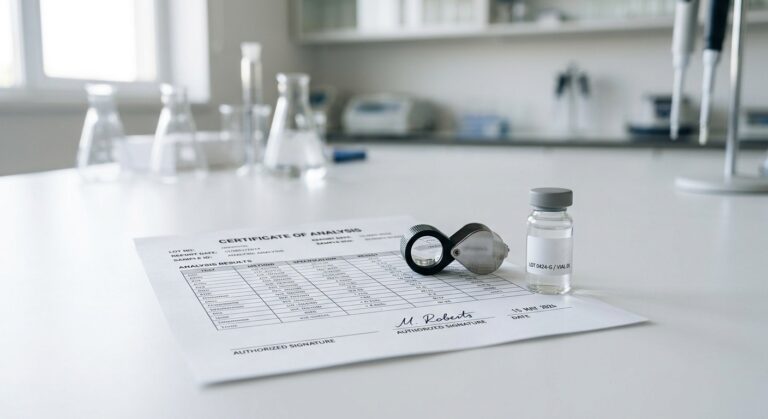
ARA-290 in 2026: a verification-first buying guide
For qualified researchers. Clarion Peptides products are sold for laboratory research use only. They are not for people or animals. This page is about checking a research material, not using one.
The short answer. Before you buy ARA-290, ask the seller for the lab report on that batch. A good report shows five things. The lab’s name is on it. The batch weighs what ARA-290 should weigh. It says how pure the batch is, as a percent. The batch number on the report matches the number on the vial. And you can check the report with the lab, not just with the seller. If the seller cannot show you all five, buy somewhere else. The technical part below explains the numbers.
What ARA-290 is, in plain words
ARA-290 is a small man-made peptide. A peptide is a tiny chain of amino acids. Amino acids are the building blocks of proteins. ARA-290 is a chain of 11 of them. Its shape is copied from one small part of EPO, a hormone the body makes. It comes as a dry white powder in a small glass vial, and labs keep it frozen. It is also called cibinetide. Its ID number is CAS 1208243-50-8.
What scientists use it for
Scientists use ARA-290 in the lab to study a switch on cells. The switch is called the innate repair receptor. It is made of two parts, and one part is the receptor for EPO. Researchers measure how well ARA-290 attaches to the switch. They record what signal the cell sends next. They also check that ARA-290 does not send the signal EPO uses to make red blood cells. This work is done in dishes of cells and in animal studies. Source: Brines and others, 2008 (PMID 18676614). This page is about lab research only. It does not cover studies in people. Nothing here says what ARA-290 does in a person.
The five checks, in order (technical)
1. The laboratory is named on the certificate
“Third-party tested” names nobody. A real certificate of analysis names the laboratory that produced it, carries a report number, and the laboratory will confirm that number if you ask. If a vendor’s page says “independent lab” and stops there, stop there too. Two laboratories serve this segment with reports you can confirm directly: Janoshik Analytical, whose results are looked up by code at verify.janoshik.com, and Freedom Diagnostics Testing in Franklin, Tennessee, which publishes reports on its own database. Also check who the report was issued to. A test the vendor ordered on its own stock tells you more than one the factory ordered before the product shipped.
2. Identity by mass spectrometry, and the mass actually matches
ARA-290’s formula is C51H84N16O21. Its monoisotopic mass is 1,256.60 Da and its average mass is 1,257.31 Da. The first of its 11 amino acids is pyroglutamate, a glutamine that has closed into a ring. A mass-spectrometry result proves the vial holds the molecule on the label, and the expected numbers are fixed by the formula, so you can check them without trusting anyone. A certificate usually reports the observed value at one of the common charge states:
- [M+H]+ near 1,257.61
- [M+2H]2+ near 629.31
- [M+3H]3+ near 419.87
The certificate should say which charge state it reports, and the difference between observed and expected should be small. One ARA-290-specific trap: if the first amino acid has not closed into its ring, the molecule is 17.03 Da heavier, so [M+H]+ lands near 1,274.63 instead of 1,257.61. A certificate that shows that mass, or a mass with no charge state, has not confirmed ARA-290. Salt form matters for weight, not identity: acetate or TFA salt vials weigh a little more than the free peptide, which is why a good certificate reports identity, purity and net content separately.
3. Purity by RP-HPLC, as a main-peak percentage with the method named
Purity answers a different question from identity: how much of what is in the vial is the target peptide. The number that holds up is the main-peak area from reverse-phase HPLC, stated as a percentage, with the method printed on the certificate and the chromatogram shown. A “99%” that appears only in marketing copy is just a claim.
4. The lot code on the certificate is the lot code you receive
If the same certificate shows up for every batch, nobody tested your batch. The lot code for the vials you would receive has to appear on the certificate, exactly. If a vendor cannot tell you which lot you would receive and show you that lot’s certificate before you pay, you are buying blind.
5. You can authenticate the certificate with the laboratory, not the seller
This is the step that takes the vendor out of the picture. Enter a Janoshik code at the lab’s own portal and compare. If the portal and the vendor’s copy disagree, the portal wins. A Freedom Diagnostics report lives on the laboratory’s own database under a search code, and the lab will confirm it. If a vendor’s certificates exist only on the vendor’s own site, all you have is a PDF.
Red flags specific to ARA-290 listings
- A product page that describes effects or dosing instead of chemistry. That copy tells you what the seller wants to sell, and nothing about what is in the vial.
- Identity reported at a mass near 1,274 instead of 1,257, or a mass with no charge state.
- Purity quoted with no chromatogram and no named method.
- A certificate whose compound name or vial size does not match the listing.
- No lot code anywhere on the page.
- A “verified” badge or QR code that lands on the vendor’s own page instead of a laboratory record.
Clarion’s current ARA-290 lot, checked the same way
Read this the way you would read a competitor’s block, and check it against the laboratory rather than against us.
| Lot | RA10, 10 mg vials. Product page: clarionpeptides.com/product/ara-290/ |
| Laboratory | Freedom Diagnostics Testing, Franklin, Tennessee. The certificate names the laboratory and names Clarion Peptides as the client: we sent the sample ourselves. Received July 24, 2026, reported July 28, 2026. |
| Identity | Confirmed by LC-MS. The report shows [M+H]+ at 1,257.5 and [M+2H]2+ at 629.3, against 1,257.61 and 629.31 expected for the ring-closed form. |
| Purity | 99.18% main peak by HPLC with UV detection, chromatogram on the certificate. |
| Net content | 10.92 mg measured in a 10 mg vial. |
| Authentication | The certificate is on the laboratory’s own database, not our server: coas.freedomdiagnosticstesting.com/Clar2607240036.pdf (search code Clar2607240036). The lot is also on the Public Lot Ledger, and the walkthrough is at clarionpeptides.com/verify/. |
When lot RA10 sells out, the product page and the ledger show the next lot. If the ledger says “assay in progress” for a lot, we don’t list a purity for it.
More on choosing a supplier
The general checklist for any research-peptide supplier, not only for ARA-290, is How to Choose a Research-Peptide Supplier.
Where to buy ARA-290, in one line
Buy the lot whose certificate you confirmed with the laboratory before paying. If that is ours, the product page is linked above. If it is someone else’s, the check works the same way.
All Clarion Peptides products are for laboratory research use only. Not for human or veterinary use. Nothing on this page is a claim about the effects of any compound.